


It's Monday morning at a global manufacturer of industrial motors. The planning system has run overnight, and by 7 a.m. it has produced a beautiful plan. Given a demand forecast of 20,000 units for its flagship drive, it has scheduled the production line, committed delivery dates to thousands of customers, and released just enough raw material to land on the target inventory almost to the unit. On paper, the week is optimal.
By Tuesday, the plan is fiction. A large customer triples an order. A supplier's shipment of castings slips by three days. One production line goes down for a shift. None of these events were in the forecast, and the "optimal" plan had no room to absorb them, because on Monday every bit of slack looked like waste. So the planner spends the rest of the week doing what planners everywhere do: overriding the system by hand, expediting freight at a premium, calling customers to renegotiate dates, and robbing one order to rescue another. On Friday the system re-optimizes against the new numbers and produces another beautiful, brittle plan for next week.
Nothing here is a software bug. The optimization algorithm did exactly what it was asked to do. The problem is what it was asked to do: find the perfect answer to a single guess about the future.
To win in an increasingly uncertain world, enterprises don't need a better guess. They need a different way of deciding.
The illusion of the point forecast
Deterministic planning is not useless. In stable, low-variance environments it works fine, and it will remain the right tool for plenty of decisions. The trouble starts when we take a method built for a "known" world, apply it to a volatile one and then act surprised when it breaks.
The most common form of this mistake is over-reliance on a point forecast. A single-number prediction ignores variance and creates only the illusion of informed decision-making. A point forecast is like a laser pointer in the fog: it illuminates one coordinate perfectly while leaving the surrounding terrain, and the "fat-tail" risks hiding in it, in total darkness.
Yet this is how most enterprises still decide. They run sophisticated optimization on top of a single demand forecast, inventory optimization, for example, and the algorithm dutifully returns the mathematically optimal plan for that one number. But the optimum is only as good as the number beneath it. When reality lands even slightly off the forecast, the "optimal" inventory becomes the wrong inventory: too little of what customers actually ordered, too much of what they didn't. What follows is a re-optimization loop in which Tuesday's manual workarounds quietly overwrite Monday's optimized plan. Without a framework built for uncertainty rather than false precision, companies never escape the firefighting. They simply re-optimize their way from one surprise to the next.
A first, very effective improvement is to move from point predictions to quantile predictions. Instead of committing to one number, a quantile forecast describes the whole shape of what could happen. It might tell you demand has a 50 percent chance of exceeding 1,000 units but a 10 percent chance of exceeding 1,800. This lets you size buffers to a deliberate service level rather than to a single guess. The fat tail is no longer hidden in the fog. You can see it, and decide how much of it you are willing to cover. (We'll dig into the benefits of quantile predictions in a later post.)
But here is the crucial distinction. A better forecast changes what you know. It does not change how you decide. And even a perfect probabilistic forecast is still only an input, because real operations are not a single bet placed once. They are a long sequence of decisions, where today's order, allocation, or production choice reshapes the situation you face tomorrow, and new information keeps arriving the whole way through. Optimizing against a distribution at a single moment does not capture that. Multi-stage stochastic optimization gets closer, but the deeper shift is this: enterprises need a way to make good decisions repeatedly, as uncertainty unfolds and the state of the business keeps changing.
That is the move from plans to policies. A plan is a fixed answer for one imagined future. A policy is a rule that maps the current situation to the best next decision. A way of deciding that keeps working as the situation changes. Strictly speaking, the Monday planner already follows a policy: re-optimize each week against the latest numbers. The problem isn't the re-optimization. Optimizing against a single guess and never testing against the range of futures it will actually meet, is what leads to bad decisions. A better policy doesn’t need to stop solving an optimization online. It needs to anticipate uncertainty and be judged on how it holds up across that whole range. Companies don't need a better Monday plan. They need a policy that already knows, in principle, what to do when supply slips and the big order lands.
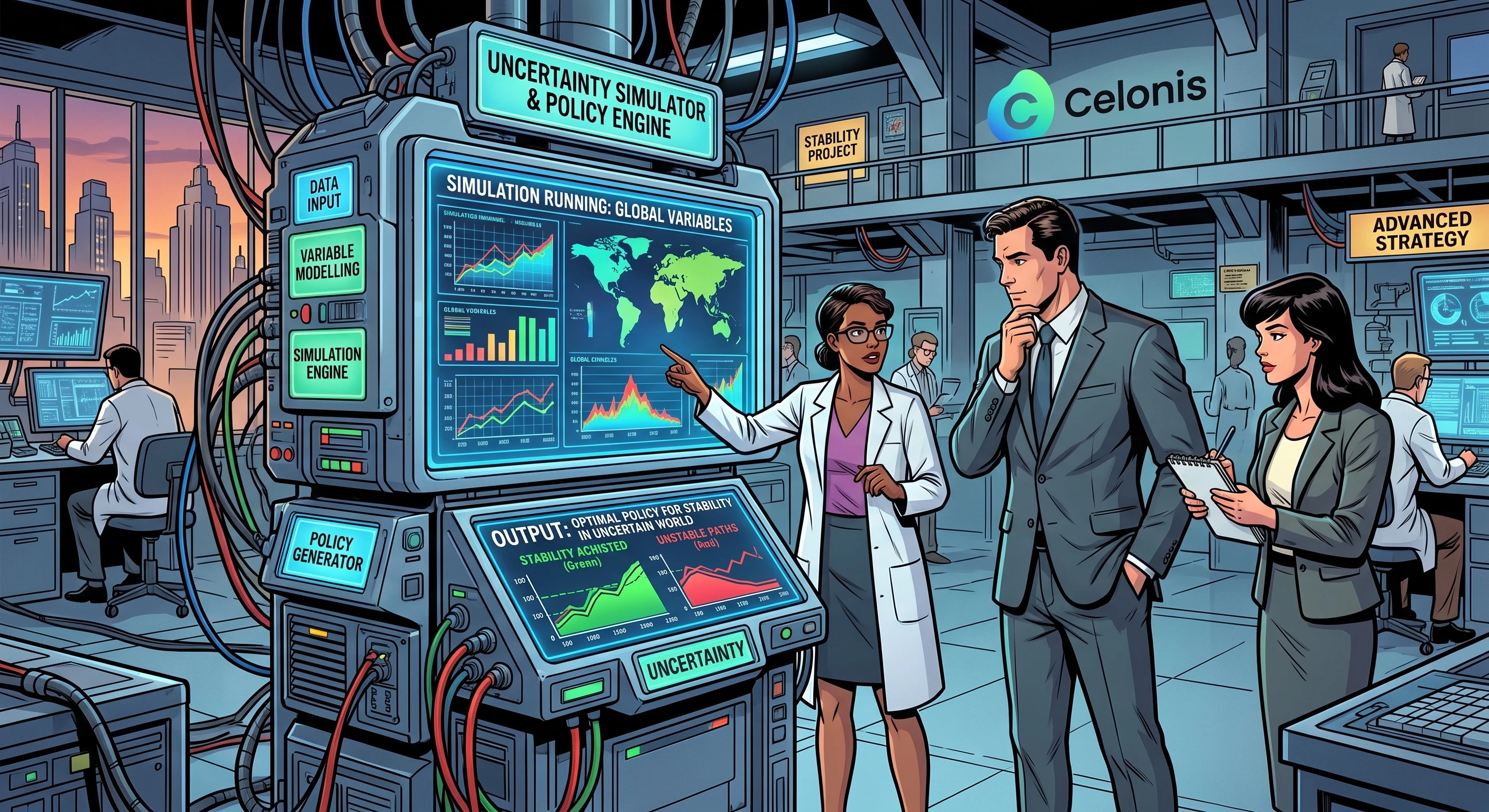
To be able to create such advanced policies you need two core features: A context model of your enterprise that knows the physics of your supply chain and a simulation engine to evaluate and fine-tune your policies.
The context model of your enterprise
You first need a shared, precise description of how your enterprise actually runs. This builds on a well-established formulation of sequential decision-making under uncertainty, organized around five building blocks. They are worth stating plainly, because almost every operational decision — inventory, allocation, production, pricing, routing — fits them.
- State. The current situation. What is in stock, what is in transit or what has been ordered, together with your best current belief about what comes next.
- Decision. The choices you control. Which order to fill, how much to produce, what price to set or where to route a shipment. A policy is simply how you set these levers, whatever method you use to choose them.
- Exogenous information. Everything you do not control, that arrives after you decide. New orders, a late supplier, a machine that fails, weather that shifts. It is the part of the world that keeps surprising the plan.
- Transition. How the situation updates. Take the current state, apply your decision, let the new information land, and you arrive at the next state. This is the logic that describes how your business actually moves from one moment to the next, and it is where much of the real complexity lives.
- Objective. How you keep score. Not performance at a single snapshot, but cumulative results across the whole horizon, adjusted for the risks you are willing to take. This is where risk becomes explicit. A policy that maximizes expected profit while quietly loading up tail exposure is not the same as one that protects against the bad 5 percent of weeks. A decision that looks optimal today but creates fragility next month is a bad decision, and the objective is what makes that visible.
These five blocks are the context baseline enterprises need in order to reason about, test, and steadily improve their decision-making.
Simulation as the engine, and why the model behind it matters
Once you have described your enterprise with these five elements, especially the transition, which captures how your business moves from one state to the next, you have effectively built a sandbox. With a simulator you can replay uncertainty thousands of times, expose any candidate policy to demand that spikes, suppliers that slip, and machines that fail, and watch how it performs before a single real order is committed. Instead of finding the perfect answer for one imagined future, you test how a way of deciding holds up across the full range of futures that could actually occur. Including the ones hiding in the tail.
There is an honest caveat here, and experienced practitioners will reach for it immediately: a simulator is only as trustworthy as the models inside it. Garbage in, garbage out. The value depends on a faithful transition model and on an honest model of the uncertainty itself. The correlated shocks, the non-stationarity, the fat tails you cannot estimate from thin historical data. This is precisely where domain expertise and real process data earn their keep. The dynamics of how orders, materials, and capacity actually flow through an enterprise are usually latent in its process data. Leveraging that is what turns a plausible-looking sandbox simulation into a decision-grade one.
Get that right, and the meaning of "optimization" changes. Rather than solving for a number, you search for a policy that produces good outcomes again and again as conditions change. Simulation-based optimization lets you compare very different policies on equal footing and then fine-tune the settings of the chosen policy until it performs as well as it can. Most operations teams don't have such a clean apples-to-apples policy benchmarking capability available today.
Start with the planner, then climb only as far as you must
For many decisions, the fastest place to start is not a blank sheet. Experienced planners already carry sensible rules in their heads: when to reorder, how much buffer to hold, which orders to prioritize when capacity is tight. These rules are often a strong foundation. You can encode one directly as a policy and let the simulator sharpen its parameters against real uncertainty. Keeping the hard-won intuition while removing the guesswork about exactly where to set the dials. Planners, in other words, become the strategic architect of the decision logic rather than its overnight firefighter.
For harder problems, that tuned rule is a starting point rather than a ceiling. Other families of policy, optimization that looks ahead over simulated futures, or methods that learn to anticipate, may suit the problem better. None is inherently superior, though. Which one wins depends on the problem, and the simulator is what settles it. The goal is never to use the most sophisticated approach available. It is to find the simplest policy that reliably produces good decisions, and to reach for a more advanced one only when the evidence says it pays.
Where this goes next
The shift from plans to policies is not about predicting the future more precisely. It is about building an enterprise that decides well no matter which future arrives. That is a more modest promise than perfect foresight, and a far more useful one.
In the posts that follow, we'll go deeper on three fronts: the benefits of quantile predictions, how what-if scenario simulation sharpens the judgment of domain experts, and a concrete, domain-specific case study showing how simulation helps derive better, more resilient policies.
Celonis is currently running select customer co-innovations to turn this framework into an easy-to-use product, so that next time when your supply slips and the big order lands, your optimized policies already know what to do. If you’re interested in participating in the Simulation co-innovation program, feel free to reach out!