


CHAPTER 2: THE LAYERS: FROM STRATEGY TO TECHNOLOGY
Every answer on the path from Chapter 1 passed through a set of layers. The KPI sat at the top, the order process in the middle, the ERP system below it, and the plant server at the base. The layers are not an invention for this example. They are the fixed structure that every enterprise is mapped into, and they are the reason a path can be walked at all.
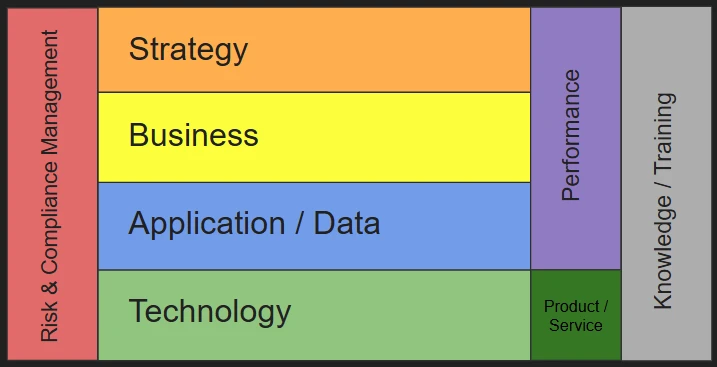
There are four layers. Strategy describes where the enterprise wants to go: the vision, the mission, the objectives, the initiatives and the KPIs that show whether progress is real. Business describes how the enterprise works: the processes that create value, the organizational units and roles that carry them out, and the capabilities the enterprise needs to do so. Application and Data describes the software that supports the work and the information it holds, such as the ERP order module and the customer orders in it. Technology describes the infrastructure underneath: servers, databases, networks and the functions that run them.
The order of the layers matters. Strategy sits at the top because it sets the direction for everything below. Technology sits at the base because it carries everything above it. A change at the bottom, such as a plant server being replaced, can affect a delivery promise at the top. A change at the top, such as a new delivery objective, can require changes in process, application and infrastructure. The layers make this visible, because the connections run through them.
Each object belongs to exactly one layer. The objective "deliver 98 percent on time" is an object in the strategy layer. The sales and planning organization is an object in the business layer. The ERP order module is an object in the application layer. The plant server is an object of the technology layer. This sounds like a small rule, but it removes a common source of confusion. When everyone agrees where an object lives, a discussion about the order process stays focused on the process, and a discussion about the server stays focused on the server.
The layers do not replace existing work. Most enterprises already have process maps in one place, an application inventory in another, a risk register in a third. The layers give these sources a common position. An application inventory becomes the application layer, a process map becomes the business layer, and the existing lists of objectives become the strategy layer. The enterprise does not need to start from zero, but it does need to agree on where each piece sits.
Finally, the layers answer a question that many teams ask without noticing: where does this belong? A new report, a new control or a new system is not added wherever it fits best on the day. It is placed in the layer where its kind of object already lives. Over time, this discipline keeps the picture stable, so that a question asked next year finds the same structure it found this year.
In the next chapter we look at the building blocks inside the layers: the objects themselves and the relations that connect them.