


INTRODUCTION: WHERE THE METHOD COMES FROM
This series describes a method, and a method is never invented from nothing. Its roots go back further than most modelling tools. In 1962 Carl Adam Petri introduced Petri nets, a formal way to describe processes with parallel steps and conditions. Between those foundations and the integrated views of the early 1990s lay a productive period. Peter Chen's entity-relationship model (1976) gave data a clear form, structured analysis and data flow diagrams made processes and their interfaces visible, and the first enterprise architecture frameworks, such as Zachman's in 1987, asked which views an enterprise needs. Each contributed one piece of the picture. Out of this work, August-Wilhelm Scheer began describing enterprises as connected views: functions, data, organisation and processes. The idea that these views belong together in one consistent picture, rather than in separate documents, shaped much of the work that followed.
Since then, many methods have appeared, and most of them have one of two shapes. Some are comprehensive and complex, so that a full implementation takes longer than the decisions it is meant to support. Others are strong in one discipline, such as enterprise architecture, and leave the rest of the enterprise out of view. Both kinds are valuable, but many organisations still lack what they need most: a method that is holistic, manageable, and able to grow with the enterprise.
After ARIS, the field split in two directions. One aimed at stricter standards and enterprise architecture: ArchiMate organised the enterprise into layers, and BPMN provided a notation that software can execute. The other turned to data: process mining reconstructs real processes from event logs, and enterprise knowledge graphs link architecture models with operational data. Both directions answered real needs, but few offer a complete structure that also stays small enough to use. By 2018, analyst research had picked up the term "digital twin of an organization" for a model that combines enterprise architecture with operational data. The layers of the method presented here follow the same logic as ArchiMate. What is new is how these layers are combined with a fixed catalogue of relations and with the rule of walking a path through recorded facts.
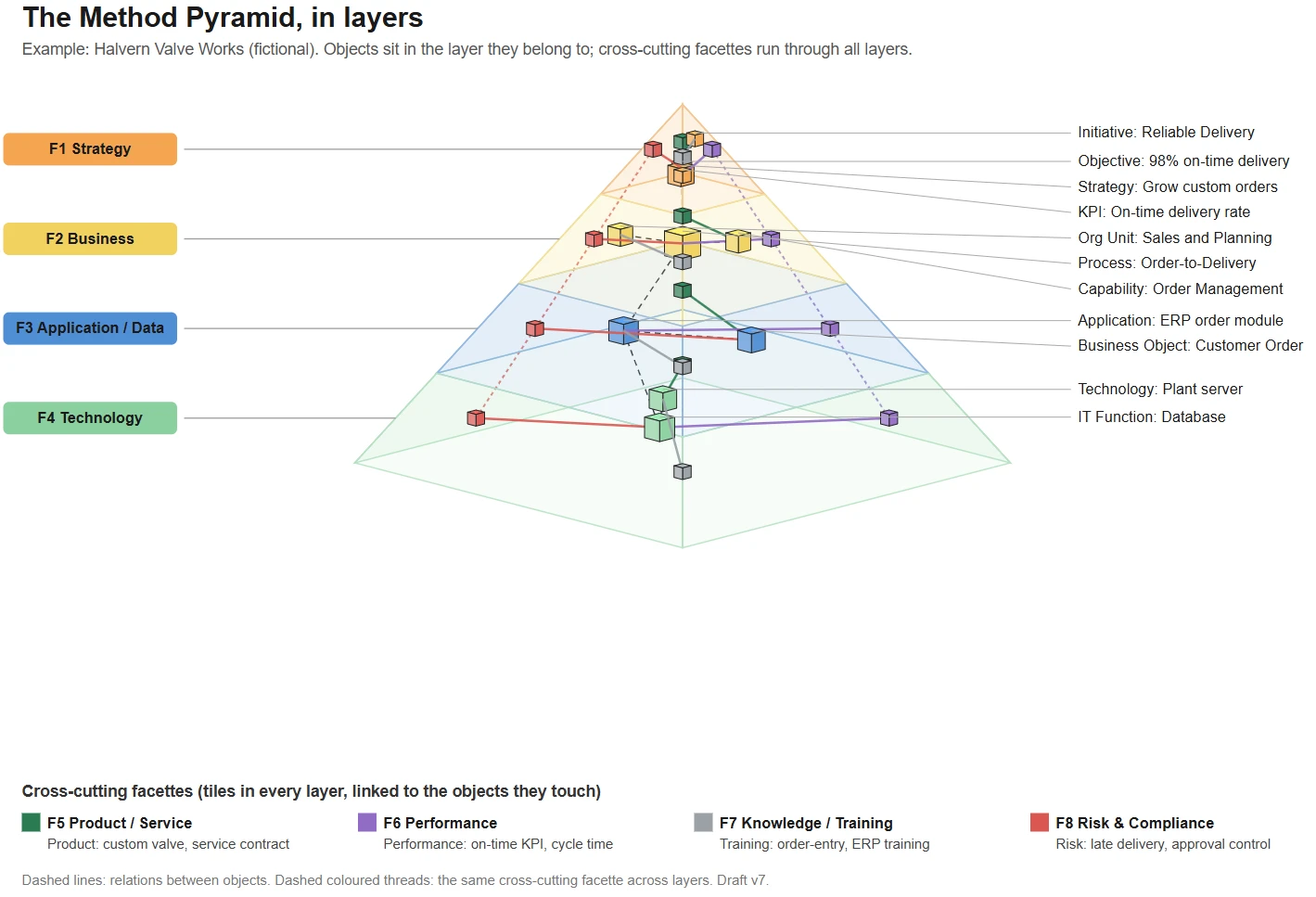
That is the gap this series addresses. The method presented here is built as a pyramid. Its four core layers run from strategy at the top, through business and application and data, down to technology. Around them sit four cross-cutting areas: risk and compliance on one side, performance and products and services on the other, and knowledge and training at the edge. Together they form a grid that describes any enterprise in the same way, and the grid can be extended when a new kind of question arises. The grid is the meta-metamodel of the method: the fixed rules that define how the models themselves are built. The goal, a planning picture that people can read without a training course, is the same one the early work pursued, and the term "digital twin" came only later, around 2015, as a marketing label.
In the last fifteen years, attention shifted to tools, dashboards and, more recently, to artificial intelligence. Yet the question the early work tried to answer has become more urgent, not less. An AI system that answers business questions is only as reliable as the structure behind it. If the enterprise has no consistent definition of its objects and relations, a fluent answer can still be wrong. Structured information is therefore the precondition for trustworthy answers, and a method that provides it is becoming a necessity.
The method in this series is a further development that brings several methods and approaches together into one framework. It is compact enough to explain in a single picture and flexible enough to extend. It relies on a fixed set of layers, a fixed catalogue of relation types, and a rule that every question is answered by walking a path through recorded facts. The first chapter starts from the practical problem. The rest of the series explains how the method is built and why it has the shape it has.
In plain terms, the method is a scaffold. It breaks what an enterprise knows into small, named pieces, arranges them in a fixed structure, and records them in a form that a computer can read as well as a person. That is what allows the same question to be answered in the same way, by a colleague, a system or an AI Agent.