



On July 18th, Pune came alive with curiosity, conversation, and a shared excitement for the future of Process Intelligence. The Pune Process Intelligence Community Event brought together students, practitioners, and professionals eager to explore how process mining is transforming the way businesses operate — and how they can be a part of that transformation.
Here's a recap of everything that went down.
Setting the Stage: What Is Process?
We kicked things off with a foundational question that sounds simple but unlocks everything: what is a process?
A process is a series of linked actions taken to achieve a particular end. In a business context, it's a collection of related, structured activities that produce a service or product. The key insight the session drove home was that every business is a collection of interconnected processes — from procurement and logistics to finance, IT, and customer service. These processes span across departments and systems, touching every corner of an organization.
The challenge? Processes are hard to see and even harder to improve. There's almost always a gap between how a process was designed, how the business thinks it runs, and how it actually runs in practice. Process mining exists to close that gap.
From Data to Discovery: The Mechanics of Process Mining
Every time an employee clicks a button, approves a purchase order, or ships a package, a digital footprint is left behind in enterprise systems — ERPs, CRMs, ticketing tools, sensors. Process Mining harnesses these footprints.
At its core, Process Mining requires three things from your data: a unique case identifier, an activity name, and a timestamp. From this event log, algorithms reconstruct the real process model — not the intended one, but the one that actually happened, with all its detours, rework, and bottlenecks visible.
The discipline sits at the intersection of Process Science (process management, automation, operations) and Data Science (machine learning, statistics, predictive analytics), as famously defined by Wil van der Aalst. Process Mining bridges model-based process analysis with data-centered analytics — making it a uniquely powerful lens for operational improvement.
Going Deeper: Object-Centric Process Mining
One of the session's most exciting segments introduced Object-Centric Process Mining (OCPM) — and why it represents a leap forward from traditional, case-centric approaches.
Traditional process mining lines up all events behind a single, predetermined case ID (e.g., a purchase order item). This works well for isolated processes, but real business operations don't run in a straight line. A single sales order can relate to multiple shipments; a single shipment can relate to multiple invoices. Forcing this complexity into a case-centric model creates distortions — duplicate records, inaccurate throughput times, and missed cross-process insights.
OCPM takes a fundamentally different approach. It models your business as objects, events, and the relationships between them — a true digital twin of operations. Instead of one model per process anchored to a single object, OCPM produces one scalable data model that captures the full picture across Procurement, Order Management, Accounts Payable, Accounts Receivable, and beyond.
The practical advantages are significant:
- Faster time-to-value with flexible, low-code setup — no repetitive coding or transformation required.
- True end-to-end analysis, identifying performance drivers across entire value chains rather than siloed process views.
- Accurate counts and throughput times with no modeling artifacts — the numbers reflect reality.
- New categories of use cases, including cross-process analysis that simply wasn't possible before.
The automotive analogy from the session captures it well: a case-centric view asks what happened to a finished car. An object-centric view asks why and how — which plant built which engine, when was the seat delivered, was the exhaust filtration verified post-fitment? It's the difference between a summary and a complete story.
Live on the Platform: Celonis in Action
A hands-on Celonis platform demo brought the theory to life, walking through an Order Management scenario that illustrated how process intelligence surfaces insights that traditional reporting simply cannot. Attendees saw firsthand how the Process Intelligence Graph, built on a unified data core, enables analysis across structured and unstructured data sources — with AI woven throughout.
The Celonis platform has evolved into a composable, AI-driven operations layer that combines AI Agents, human decision-making, and automations — all powered by a digital twin of the business and enabled by MCP APIs for seamless integration.
Real-World Impact: Case Studies That Inspire
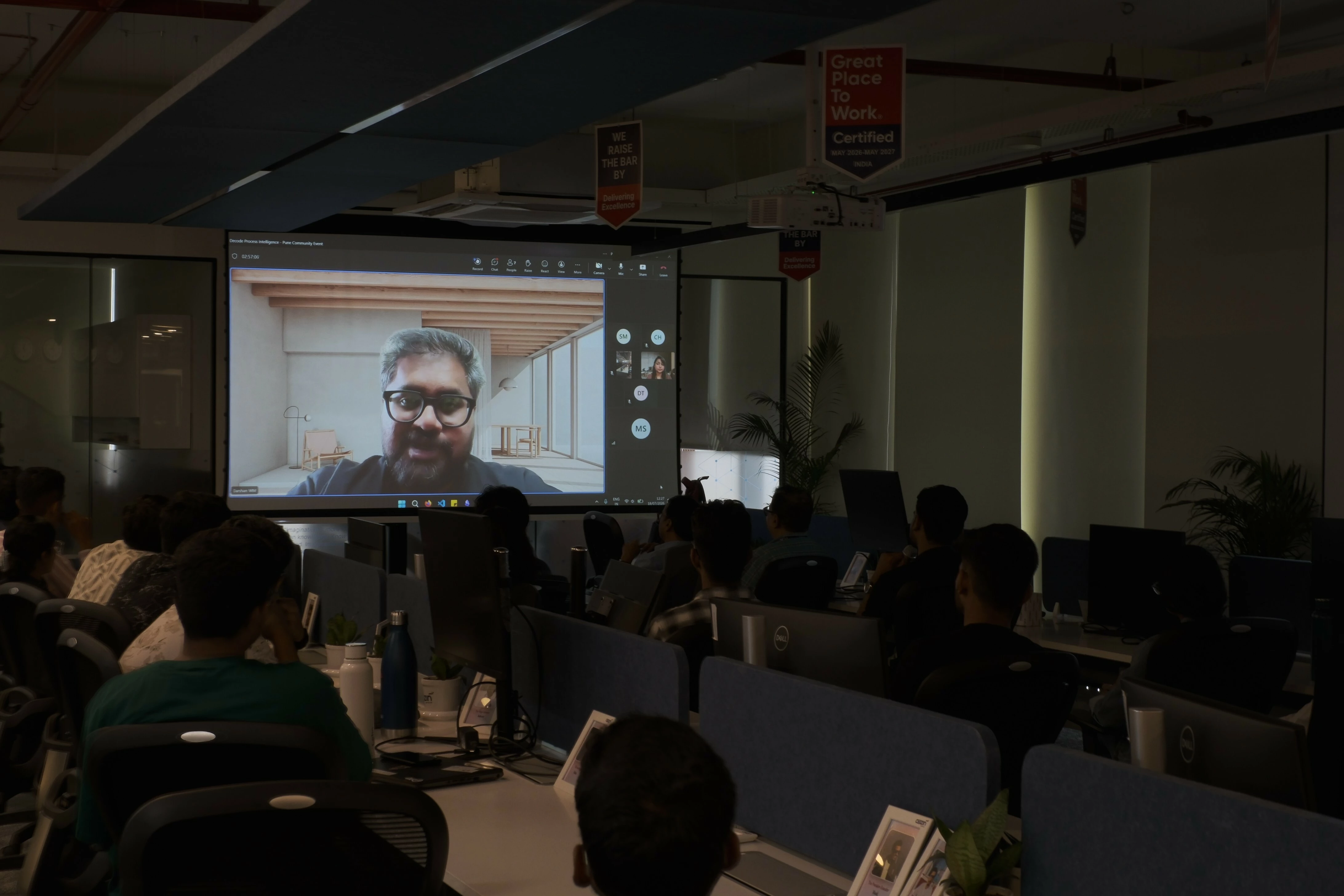
Theory and demos are compelling, but nothing lands like real outcomes. The event showcased two standout customer stories presented by Darshan WM and Garima Rawat
Cisco — Recovering Booked-but-Uninvoiced Revenue Cisco was sitting on millions of dollars in orders that had been booked but not yet invoiced. Using Celonis, they built a digital twin covering 3.5 years of complex software, hardware, and services order flows — and identified the root causes of invoice delays. The result: a target to reduce invoice follow-up time from 90 days after booking to just 30 days. As Prasad Varahabhatla, Senior Director of Process Intelligence & Automation at Cisco, put it: "For AI to be effective you must first understand your process. There is a sequence to effective automation and it starts with understanding processes."
Smurfit Westrock — AI-Powered Vendor Harmonization With vendors spread across global parent accounts and local subsidiaries, Smurfit Westrock struggled to negotiate consistent payment terms. Using Celonis Master Data AI, they mapped local vendor accounts to global parent accounts — turning a manual, months-long exercise into an intelligent, continuously improving workflow. Over 40,000 previously unmapped accounts became manageable through AI-assisted fuzzy matching, giving their procurement team a clear view of global spend.